





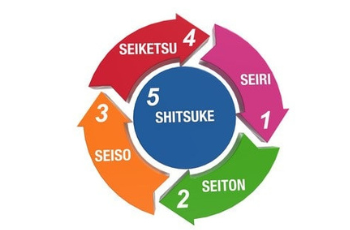
What is 5S? Introduction to the 5S Methodology
The concept of 5S (5S methodology) originated in Japan in the early 1980s.
In 1986, 5S became widely adopted in many countries such as Singapore, China, and Poland.
It was introduced to Vietnam when Japan expanded its investments, and Vikyno was the first Vietnamese company to apply 5S in 1993.
5S addresses psychological issues, improves working conditions and the working atmosphere within teams, and enhances the working environment.
5S is a simple improvement method that is easy to understand and implement, with low implementation costs but highly effective in mobilizing human resources, increasing productivity, quality, and efficiency, and reducing waste.
S1: Sort (Seiri)
Classify necessary and unnecessary items.
Remove unnecessary items.
Determine the correct quantity for necessary items.
S2: Set in Order (Systematize)
Arrange necessary items in an orderly and scientific manner.
Place the right item in the right place.
Arrange the positions of tools, machines, workers, etc. so that the workflow is smooth and continuous, without congestion or delays.
S3: Shine (Sweep)
Keep the workplace, equipment, and tools clean.
Limit the SOURCES that cause dirt and clutter.
Always clean with “Awareness”.
S4: Standardize (Standardize)
Establish a program to maintain the regular and conscious implementation of the above 3S.
Organize competitions and evaluate the implementation results among units to maintain and increase people’s attention to 5S.
S5: Sustain (Self-Discipline)
Consistently, regularly, and consciously practice the above 4S with discipline and self-awareness.
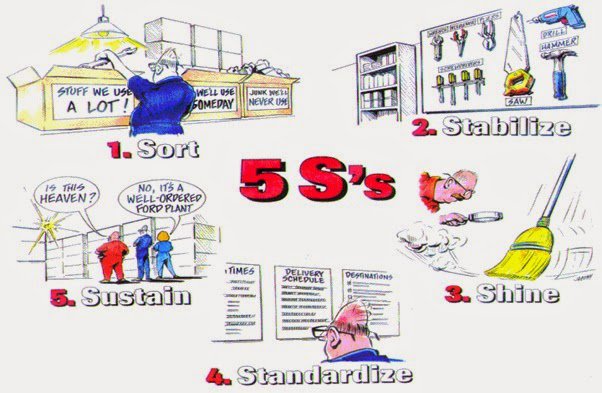
Consulting on the Application of the 5S Methodology
Objectives and Benefits of the 5S Method:
Objectives:
Eliminate unnecessary items; keep the workplace clean and well organized.
Save time and effort, avoid waste.
Build a safe and clean working environment.
Improve work efficiency and minimize errors.
Continuously improve the quality of work and product quality.
Enhance employees’ awareness, responsibility, and ethics.
Improve mutual understanding among employees and strengthen teamwork spirit.
“5S is part of daily work.”
Benefits of 5S:
The 5S program originates from practical needs such as:
Ensuring employees’ health.
Making work easier and more convenient.
Creating a positive spirit and working atmosphere.
Improving quality of life. Enhancing living standards.
Effective implementation of 5S will contribute to:
- Increasing productivity (P – Productivity).
- Improving quality (Q – Quality).
- Reducing costs (C – Cost).
- On-time delivery (D – Delivery).
- Ensuring safety (S – Safety).
- Improving morale (M – Morale).
Principles for Applying 5S:
Prepare thoroughly so that implementation is effective and achieves high results.
Plan and prepare sufficient budget to deploy and maintain 5S.
Coordinate and cooperate to implement it consistently and continuously.
Evaluate and measure the level of application fairly and transparently.
Promptly correct violations while encouraging, motivating, and rewarding appropriately.
Managers at all levels, especially senior leaders, must set examples and take the lead in actions.
Four Basic Factors for Successfully Implementing the 5S Method:
Leadership commitment and support:
A prerequisite for the success of 5S implementation is the understanding and support from leadership. Leaders need to form working groups and direct the implementation.
Start 5S with training and education:
Train everyone to understand the meaning of 5S activities and provide them with implementation methods. When people are aware and equipped with the right tools, they will voluntarily participate and actively engage in 5S activities.
Everyone voluntarily participates in implementing 5S:
The key to success in implementing 5S is creating an appropriate environment that encourages everyone to participate.
Repeat the 5S cycle with higher standards:
Implement the 5S program continuously with repeated activities to ensure the maintenance and improvement of management practices.
5S Certificate Sample
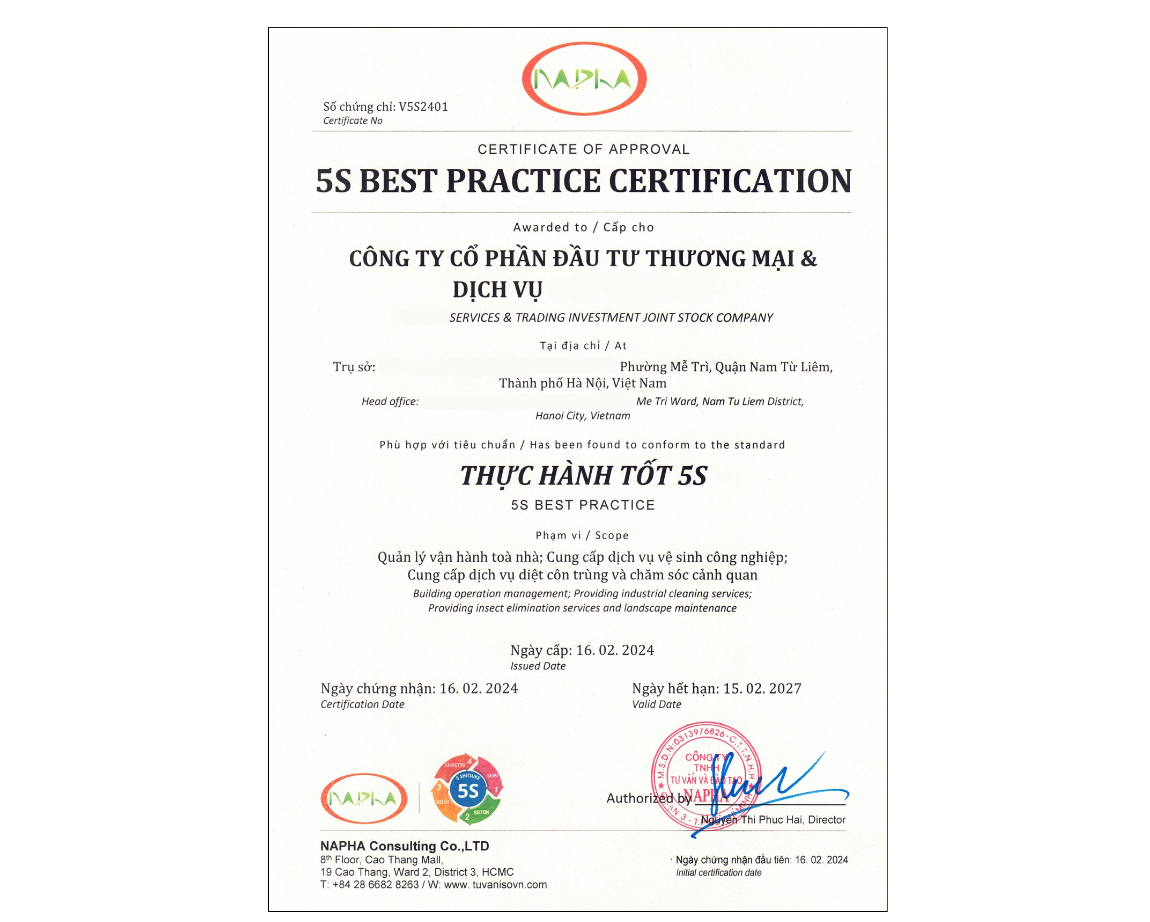
Certificate of Recognition for the Implementation of Good 5S Practices
Steps to Apply 5S:
To implement a 5S program, the first step is to develop an implementation plan, including the following steps:
Step 1: Preparation
Content:
Top management clearly understands the principles and benefits of 5S.
Learn from experiences of 5S activities.
Commit to implementing 5S.
Establish a steering committee to implement 5S.
Assign a person responsible for 5S activities.
Train the main responsible person and guiding members for implementation.
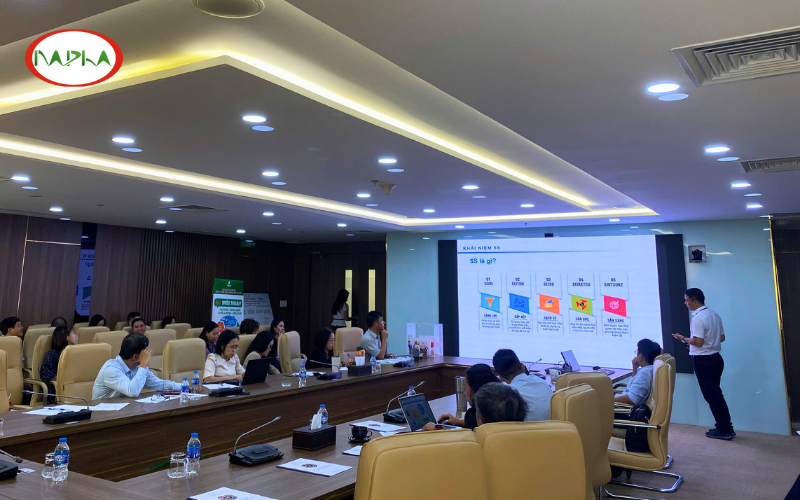
Consulting on the Implementation of 5S for Businesses in All Industries and Fields
Step 2: Official Announcement from Leadership
Content:
Official announcement of the 5S implementation program.
Present the objectives of the 5S program to everyone.
Announce the establishment of the steering committee, implementation direction, and assign groups or individuals responsible for specific areas.
Develop communication and promotional tools such as banners, posters, newsletters, etc.
Organize training on the basic contents of 5S for everyone.
Step 3: All Employees Conduct General Cleaning
Content:
Organize a “General Cleaning Day” immediately after leadership announces the implementation of 5S.
Divide areas and assign responsible groups.
Provide sufficient tools and necessary equipment.
Carry out a company-wide general cleaning day.
Sort out all unnecessary items.
Maintain two general cleaning sessions each year.
Step 4: Implement Seiri (Sort)
Content:
Establish standards for eliminating unnecessary items.
Conduct preliminary sorting to remove unnecessary items after the general cleaning day.
Everyone focuses on identifying and classifying unnecessary items and removing them.
Items that are no longer used but still have value should be re-evaluated before making a decision to dispose of them to avoid waste.
Conduct sorting regularly at the workplace and organize company-wide sorting twice a year.
When, who, and where should sorting be done?
On general cleaning day, everyone should try to remove unnecessary items.
Twice a year, organize a Seiri day and focus on removing all unnecessary items.
During the implementation of Seiri, Seiton, and Seiso activities, always try to remove unnecessary items and prevent waste caused by the accumulation of unnecessary things.
Leadership and 5S evaluation experts should inspect the workplace and provide necessary guidance.
Step 5: Implement Seiri, Seiton, and Seiso Daily
Regularly remove unnecessary items to make better use of the workplace.
Continuously seek and implement improvements in storage locations and methods to minimize the time required to search for and retrieve items.
Establish schedules and perform daily cleaning to create a comfortable environment that ensures health.
Encourage everyone to contribute improvement ideas at the workplace.
Practicing Seiketsu:
When Seiri, Seiton, and Seiso are properly implemented, the workplace becomes clean and organized. This is called Seiketsu (Standardize/Care).
To maintain and enhance 5S, the following effective methods should be used:
Leadership evaluates 5S activities.
Create competitions between departments regarding 5S.
Create competitions between companies regarding 5S.
Practicing Shitsuke:
Meet people with a friendly smile.
Listen attentively.
Work enthusiastically and always seek improvements.
Have a team spirit.
Practice the attitude of being a member of a reputable organization.
Always try to be punctual.
Keep the workplace clean and tidy.
Strictly comply with safety regulations.
Step 6: Periodic 5S Evaluation
5S activities must be maintained regularly and continuously improved. To encourage maintenance and improvement, evaluation activities are necessary. Evaluation activities include:
- Develop evaluation plans and encourage 5S activities.
- Evaluators regularly assess 5S activities.
- Launch emulation movements among departments regarding 5S activities.
- Provide periodic rewards for teams and individuals who perform 5S well.
- Organize visits to learn about 5S implementation in other units.
- Organize 5S competitions among companies to further improve implementation.
Daily 5S Implementation Methods:
- Everyone performs 5S for about 10 minutes at their workplace every Friday (both personal and common areas).
- Every month, conduct company-wide 5S activities for about 30 minutes during working hours (common areas such as offices, workshops, canteens, restrooms, etc.).
- Everyone shares implementation experiences.
- Create a convenient workplace.
- Continuously improve the working environment.
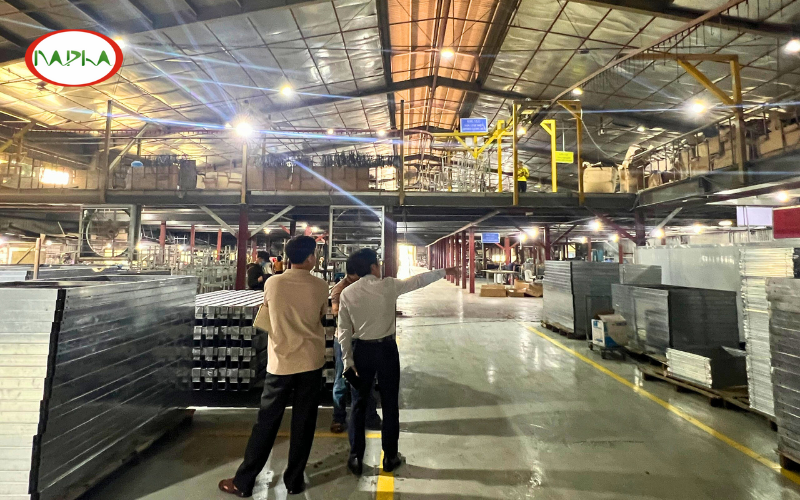
Consulting on the Implementation of 5S for Manufacturing Enterprises
10 Suggestions for Successfully Implementing 5S:
- Two heads are better than one – maximize the use of brainstorming methods.
- Always be aware of identifying inconvenient points for improvement.
- Always be aware of identifying untidy workplaces for improvement.
- Identify unsafe work areas for improvement.
- Identify workplaces that are unsafe and not clean for improvement.
- Identify points of waste in order to eliminate them.
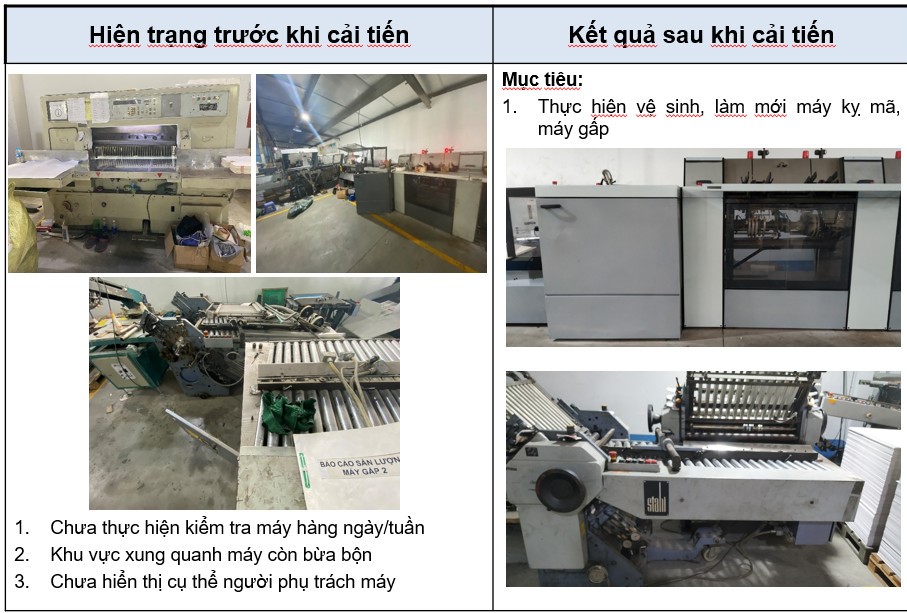
- Expand the scope of cleaning machine surfaces.
- Pay attention to public areas such as the canteen, restrooms, gardens, corridors, and parking lots.
- Point out evidence showing that employees need to strengthen 5S activities.
- Effectively use visual management methods.
What Benefits Do Businesses Gain from Applying the 5S Standard?
5S is a simple improvement method that is easy to understand and implement, with low implementation costs but very effective in mobilizing human resources and improving productivity, quality, efficiency, and reducing waste. Below are the specific benefits for businesses applying the 5S system:
- Eliminate unnecessary items; maintain a clean and well-organized workplace.
- Save time and effort, avoiding waste.
- Build a safe and clean working environment.
- Improve work efficiency and minimize errors.
- Continuously improve the quality of work and product quality.
- Enhance employees’ awareness, responsibility, and ethics.
Improve mutual understanding among employees and strengthen teamwork spirit.
What Are the Benefits of 5S?
In summary, what are the benefits of applying the 5S standard?
Proper implementation of the 5S standard will contribute to:
- Increasing productivity (P – Productivity)
- Improving quality (Q – Quality)
- Reducing costs (C – Cost)
- Ensuring on-time delivery (D – Delivery)
- Ensuring safety (S – Safety)
Improving morale (M – Morale)
CONTACT FOR FREE CONSULTING VIA HOTLINE: 0938.161.564
NAPHA CONSULTING CO., LTD
Địa chỉ: 3 Floor, An Phu Plaza, 117 - 119 Ly Chinh Thang Street, District 3, HCMC
Email: tuvannapha@gmail.com
main.comment_read_more