





6 COMMON ESG RISKS AND HOW TO MITIGATE THEM EFFECTIVELY
ESG is no longer a trend—it has become a mandatory requirement in global supply chains. However, many businesses are still exposed to hidden risks that may lead to order losses, operational disruptions, or even exclusion from export markets. Below are six typical ESG risks and practical mitigation measures.
1. Surprise Audits
Impact: Rating downgrade and potential loss of up to 50% of orders
→ Immediate factory suspension and loss of key contracts
2. Mismatch Between Documentation/System and Actual Operations
Impact: Loss of customer trust and rejection of shipments
→ Non-compliance and disruption of product flow
3. Product Recall
Impact: Multi-million USD losses
→ Logistics costs, product destruction, and brand damage
4. Greenwashing
Impact: Loss of credibility, legal exposure, and consumer backlash
5. Carbon Border Adjustment Mechanism (CBAM)
Impact: Carbon costs erode profit margins
→ Increased export costs and reduced competitiveness
6. Sub-supplier Blind Spots (Tier 2 & Tier 3)
Impact: Hidden labor violations
→ Legal risks and potential global supply chain suspension
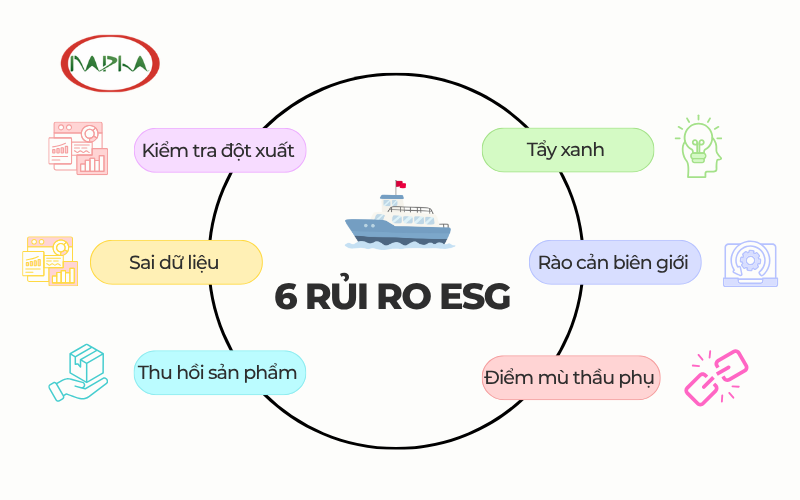
6 typical ESG risks that businesses may encounter
DETAILED ESG RISKS & MITIGATION MEASURES
RISK 1: Greenwashing
Definition:
Misleading claims about environmental performance—presenting the company as “greener” than it actually is.
Potential Impact:
Significant penalties under EU regulations (potentially up to millions of EUR), reputational damage, and long-term communication crises.
Mitigation Measures:
- Transparent reporting: Clearly disclose baseline year, targets, deviations, and calculation methodologies
(e.g., 500 tons CO₂ in 2022 → target 250 tons CO₂ by 2030)
- Third-party verification: Ensure sustainability reports are independently verified
- Accurate claims: Only communicate certified achievements (e.g., use “ASC certified” only when certification is obtained)
Incident transparency: Publicly disclose and address labor or food safety issues
RISK 2: Carbon Border Adjustment Mechanism (CBAM)
Mechanism:
Imported goods from countries with lower carbon standards are subject to carbon pricing at EU borders.
Potential Impact: Reduced price competitiveness compared to EU-based products.
Mitigation Roadmap:
1. Measurement
Classify emissions:
Scope 1: Direct fuel use (gas, diesel)
Scope 2: Purchased electricity
Scope 3: Logistics, waste
Apply tools such as ISO 14064 or emission calculators
2. Target Setting
Establish baseline (2025–2026)
Reduce 30% through efficiency improvements (2026–2030)
Achieve deeper reductions with carbon offset strategy (2030–2050)
3. Green Transition
Install rooftop solar (30–40% energy demand)
Shift to lower-emission fuels (e.g., LNG, biomass)
4. Reporting & Documentation
Update emission data annually
Maintain CBAM-ready documentation (from 2026 onward)
RISK 3: Sub-supplier Blind Spots (Tier 2 & 3)
Context:
Companies are accountable for their entire supply chain.
Blind reliance on certifications without on-site verification can lead to severe penalties.
Mitigation Measures:
Supply chain due diligence:
High-risk → Annual on-site audits
Low-risk → Remote monitoring / biennial audits
Contractual controls: Include ESG clauses, penalties, and termination rights
Grievance mechanism: Enable anonymous reporting channels with defined response timelines
RISK 4: Product Recall Crisis
Context:
A single contaminated batch (e.g., antibiotics, heavy metals) can trigger large-scale recalls and import rejection.
Potential Impact: Significant financial loss and reputational damage.
Mitigation Measures:
1. Risk-based testing
- Apply sampling based on risk levels
- Regular testing for arsenic, antibiotics
- Maintain proper records
2. Traceability records
- Ensure chemical usage aligns with farming data
- Missing records = major compliance risk
3. Supplier liability
- Require suppliers to bear recall-related costs if non-compliance is identified
4. Tracking system
- Trace full lifecycle: farm → processing → customer
- Enable rapid containment
5. Product liability insurance
- Transfer financial risk in case of recall events
RISK 5: Data Inconsistency Between System and Actual Shipment
Root Causes:
Manual records, fragmented Excel files, and inconsistent measurement standards.
Mitigation: Single Source of Truth
Standardized measurement rules:
- Fresh shrimp: weighed within 0–4 hours
- Frozen shrimp: weighed after defrosting
- Peeled shrimp: clearly defined yield ratio
Physical verification:
- Mandatory photo evidence at weighing stations
Centralized system:
- Real-time shared data platform
- All changes must be logged and approved
QA monitoring:
- Weekly anomaly checks
- Staff training: “Incorrect data = rejected shipment”
RISK 6: Surprise Audits
Context:
- Major brands (e.g., Walmart, Nestlé)
- Government authorities (tax, labor, quarantine)
Potential Impact: Loss of 30–50% of orders, fines, suspension, or legal consequences
Mitigation Measures:
- Mock audits: Conduct quarterly internal simulations
- Documentation readiness: Maintain up-to-date labor contracts, payroll, and attendance records
- Safe workplace conditions:
+ Emergency exits with proper signage (LED/photoluminescent)
+ Organized warehouse with barcode systems
- Employee preparedness:
+ Train staff to respond accurately, consistently, and truthfully during audits
ADDITIONAL HIDDEN ESG RISKS
RISK 7: Labor Law Non-compliance (Vietnam)
Violations in contracts or wages below living standards may result in penalties and legal intervention.
RISK 8: Certification Fraud
Use of invalid or fraudulent certificates may lead to permanent revocation and export bans.
RISK 9: Communication Crisis
Lack of crisis management strategy can escalate ESG incidents rapidly across media and social platforms.
RISK 10: Supply Chain Disruption
Over-reliance on a single supplier may lead to supply shortages and contract losses.
Effective ESG risk management is not only about compliance but also a critical driver for maintaining competitiveness and achieving sustainable growth in global supply chains. By proactively identifying and mitigating ESG risks, organizations can protect their reputation, optimize costs, and ensure long-term business resilience.
CONTACT FOR FREE CONSULTING VIA HOTLINE: 0938.161.564
NAPHA CONSULTING CO., LTD
Địa chỉ: 3 Floor, An Phu Plaza, 117 - 119 Ly Chinh Thang Street, District 3, HCMC
Email: tuvannapha@gmail.com


main.comment_read_more