




WHAT’S NEW IN ISO 14001:2026? KEY CHANGES IN ENVIRONMENTAL MANAGEMENT SYSTEMS
Discover the key changes in ISO 14001:2026, including climate action, lifecycle thinking, ESG reporting, and supply chain management for effective environmental systems.
The revision of ISO 14001:2026 marks a significant evolution in Environmental Management Systems (EMS), aligning organizations with global sustainability priorities, climate risks, and ESG expectations. From a consulting standpoint, these updates are not merely technical adjustments—they represent a strategic shift in how environmental performance is managed and reported.
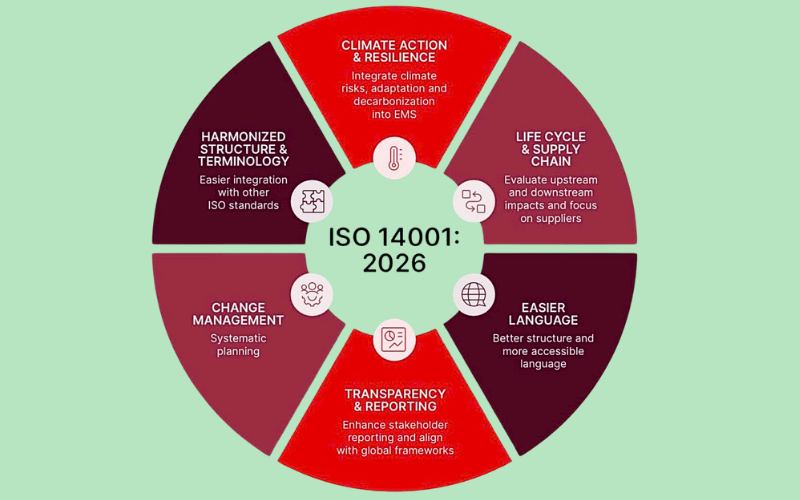
Key changes in ISO 14001:2026
1. Climate Action & Resilience Integration
ISO 14001:2026 introduces a stronger emphasis on climate-related risks and opportunities. Organizations are expected to:
- Integrate climate risks into their EMS framework
- Develop adaptation and mitigation strategies
- Align with global decarbonization initiatives
👉 This change reflects the transition from compliance-based management to climate-resilient business strategy.
2. Life Cycle Thinking & Supply Chain Management
The updated standard expands the scope of environmental responsibility beyond internal operations:
- Evaluate upstream and downstream impacts
- Strengthen supplier environmental controls
- Address indirect environmental aspects
👉 Organizations must adopt a holistic lifecycle approach to environmental management.
3. Easier Language
ISO 14001:2026 improves clarity by:
- Using more precise terminology
- Reducing ambiguity
- Enhancing usability across industries
4. Transparency & ESG-Aligned Reporting
Transparency is becoming a core requirement. ISO 14001:2026 encourages:
- Enhanced environmental reporting
- Alignment with global ESG frameworks
- Improved stakeholder communication
👉 This positions ISO 14001 as a key tool in sustainability and ESG reporting systems.
5. Systematic Change Management
Organizations are required to manage changes in a structured and risk-based manner:
- Assess environmental risks before implementing changes
- Ensure continuity and control during transitions
👉 This minimizes operational and environmental disruptions.
6. Harmonized Structure & Terminology
The standard continues to follow the Harmonized Structure (HS), enabling seamless integration with:
- ISO 9001 (Quality Management)
- ISO 45001 (Occupational Health & Safety)
👉 Ideal for organizations implementing integrated management systems (IMS).6.
What Should Your Organization Do to Prepare for ISO 14001:2026?
In light of the significant changes introduced in ISO 14001:2026, organizations are not only required to update their systems but also to proactively adapt to environmental management trends closely linked to sustainability and ESG.
From a professional ISO consulting perspective, organizations should:
- Conduct a Gap Analysis to determine the current level of compliance against the new requirements
- Review and update the Environmental Management System (EMS) to ensure full integration of climate-related and lifecycle considerations
- Strengthen supply chain control, particularly in evaluating and managing suppliers based on environmental criteria
- Develop ESG reporting capabilities to meet increasing demands for transparency and stakeholder expectations
👉 Early preparation not only enables organizations to achieve compliance, but also creates a competitive advantage in a market increasingly driven by sustainability.
Take Action with NAPHA ISO Consulting Experts
Are you looking for an effective and cost-efficient solution to implement or transition to ISO 14001:2026?
👉 We are ready to support your organization with:
- ISO 14001 implementation consulting tailored to your operational context
- Professional internal auditor training, aligned with standard requirements
- End-to-end certification support, ensuring a fast, efficient, and well-structured process
📩 Contact NAPHA Consulting today to receive a free consultation and a tailored implementation roadmap for your organization.
CONTACT FOR FREE CONSULTING VIA HOTLINE: 0938.161.564
NAPHA CONSULTING CO., LTD
Địa chỉ: 3 Floor, An Phu Plaza, 117 - 119 Ly Chinh Thang Street, District 3, HCMC
Email: tuvannapha@gmail.com


main.comment_read_more