





SHOULD BUSINESSES HIRE A CONSULTANT OR IMPLEMENT ISO 9001 INTERNALLY?
ISO 9001 Implementation: A Challenge Many Businesses Struggle With. As markets become increasingly competitive, customers are no longer concerned solely with product quality. They also expect consistency, process control, and a reliable management system. This is why more organizations are choosing to implement ISO 9001 to establish a professional and sustainable Quality Management System (QMS).
However, before starting the journey, one common question arises: Should a company implement ISO 9001 on its own or hire a professional ISO consultant?
Having advised hundreds of organizations over the past decade, I have found that this decision is not simply about cost. It is a matter of efficiency, implementation time, and the long-term value that the ISO 9001 system can deliver.
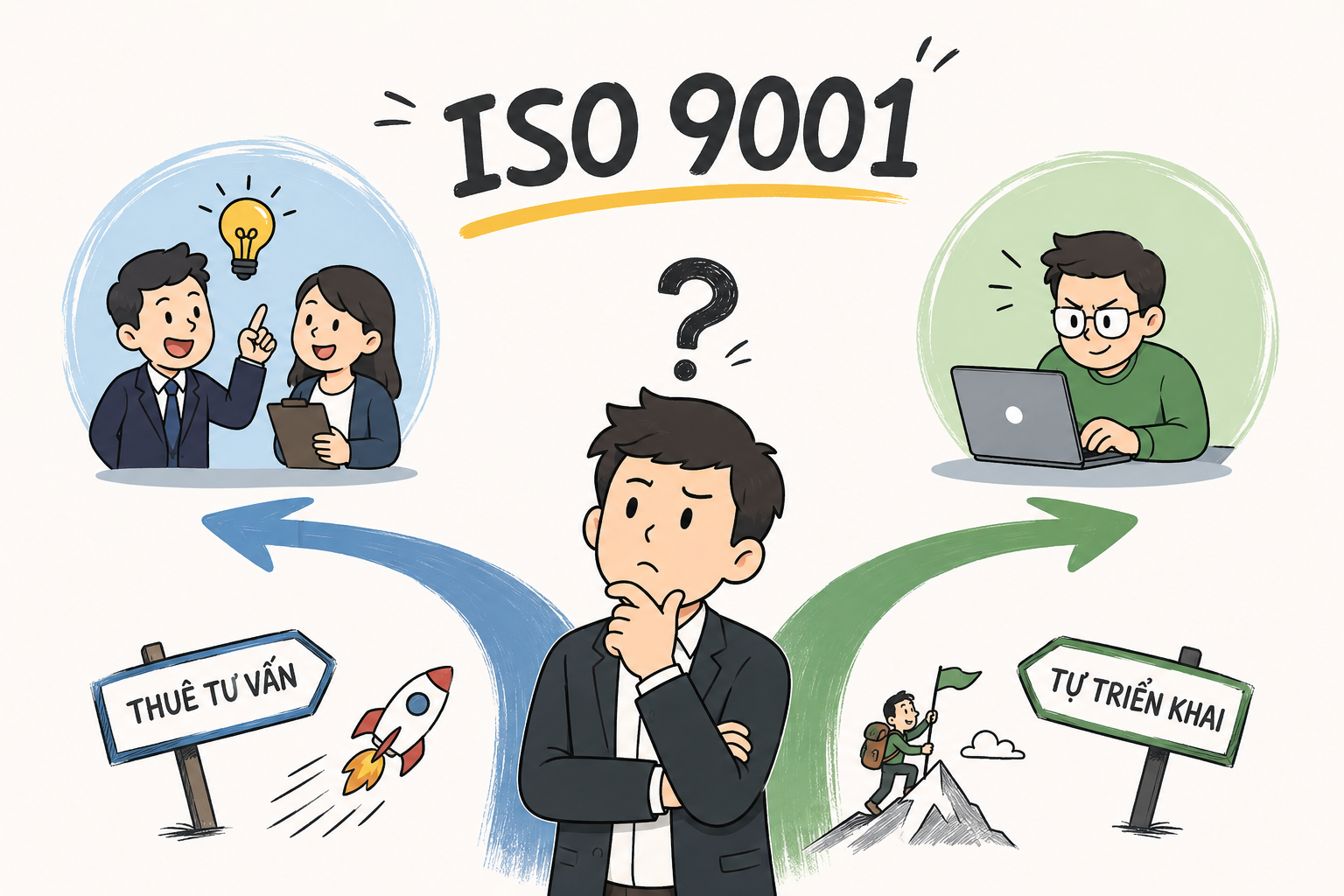
Should businesses hire a consultant or implement ISO 9001 internally?
I. Why Do Many Businesses Choose to Implement ISO 9001 Internally?
Today, ISO 9001 resources and guidance materials are widely available online. As a result, many organizations believe that self-implementation is a feasible option.
Some of the apparent advantages of implementing ISO 9001 internally include:
+ Saving consultancy fees.
+ Having full control over system development.
+ Leveraging internal personnel who understand operational processes.
For organizations with experienced quality management professionals, this may indeed be a practical approach.
However, in reality, many companies encounter challenges such as:
+ Misinterpreting ISO 9001 requirements.
+ Creating excessive documentation with little practical value.
+ Developing procedures that are not effectively implemented.
+ Receiving numerous nonconformities during certification audits.
More importantly, internal implementation often takes significantly longer than expected, increasing labor costs and diverting resources from core business activities.
*A Real-Life Example from a Manufacturing Company:
Consider a mechanical components manufacturer with approximately 150 employees.
Initially, the company decided to implement ISO 9001 internally to reduce costs. An internal project team was established and spent nearly ten months studying the standard, developing procedures, and preparing documentation.
The results were:
- More than 80 forms and templates were issued.
- Multiple procedures contained overlapping responsibilities.
- Employees perceived ISO as additional paperwork.
- Process compliance rates remained low.
During the internal audit phase, the organization discovered numerous gaps against ISO 9001 requirements.
The company then engaged an experienced ISO consultant to review and restructure the system.
Within only three months:
 Over 30% of unnecessary documents were eliminated.
Procedures were simplified and streamlined.
Roles and responsibilities among departments were clearly defined.
Employees received practical, application-focused training.
Ultimately, the company achieved ISO 9001 certification on its first certification audit, while production defect rates decreased significantly within the first year of implementation.
This example highlights an important lesson:
The greatest cost is often not the consulting fee, but the time and resources wasted when a management system is built incorrectly from the outset.
II. What Value Does an ISO 9001 Consultant Bring?
For most organizations implementing ISO 9001 for the first time, engaging an experienced consultant often provides greater overall value.
1. Faster Implementation
Experienced consultants understand where to start, which requirements require priority attention, and which activities add little value.
As a result, implementation timelines can often be reduced by several months or even up to a year, depending on organizational size and complexity.
2. A Management System Tailored to Business Reality
One of the most common mistakes organizations make is implementing ISO 9001 solely to obtain certification.
Professional consultants focus on designing a system aligned with actual business operations, ensuring that ISO becomes a management tool rather than a collection of documents created merely for audit purposes.
3. Reduced Certification Risks
Drawing on extensive practical experience, consultants can identify weaknesses and potential nonconformities before the certification body conducts the external audit.
This significantly improves the likelihood of a successful certification outcome.
4. Effective Employee Training
A successful ISO 9001 implementation is not measured by the number of procedures issued but by how well employees understand and apply the system.
This is one of the most valuable contributions an experienced consultant can provide.
III. When Should a Business Implement ISO 9001 Internally?
Organizations may consider self-implementation if they:
Have previous experience with management systems.
Employ experienced QA professionals or a competent QA Manager.
Have personnel formally trained in ISO 9001 requirements.
Are not under pressure to achieve certification within a short timeframe.
Under these circumstances, internal implementation may reduce initial project costs.
IV. When Should a Business Hire an ISO 9001 Consultant?
Hiring a consultant is generally the better option when:
The organization is implementing ISO 9001 for the first time.
Rapid certification is a priority.
Internal expertise is limited.
Process optimization is a key objective.
The organization seeks operational improvement rather than merely obtaining certification.
This is particularly true for small and medium-sized enterprises (SMEs), where external expertise can help avoid costly implementation mistakes.
Expert Perspective: Don't Compare Costs Alone
Many business leaders ask: Consulting services may cost tens or even hundreds of millions of Vietnamese Dong. Is it really worth the investment?
A more appropriate question would be: How much will the organization lose if the ISO project is delayed by six months or has to be rebuilt from scratch?
When evaluating an ISO 9001 implementation project, organizations should consider:
- Internal labor costs.
- Opportunity costs caused by project delays.
- System redesign and corrective action costs.
- Additional audit and reassessment expenses.
In many cases, investing in professional consultancy services proves to be the most cost-effective solution in the long run.
V. Conclusion
Both self-implementation and consultant-led implementation have their own advantages and limitations.
However, for organizations adopting a Quality Management System for the first time, working with an experienced ISO consultant is often the safer and more effective approach.
A successful ISO 9001 implementation does far more than achieve certification. It helps standardize processes, reduce errors, improve productivity, and establish a strong foundation for sustainable business growth.
Remember: The ultimate objective of ISO 9001 is not a certificate displayed on the wall—it is a management system that creates measurable value for the organization every single day.
CONTACT FOR FREE CONSULTING VIA HOTLINE: 0938.161.564
NAPHA CONSULTING CO., LTD
Địa chỉ: 3 Floor, An Phu Plaza, 117 - 119 Ly Chinh Thang Street, District 3, HCMC
Email: tuvannapha@gmail.com


main.comment_read_more