





ISO 22000 CERTIFICATION PROCESS AT A CERTIFICATION BODY
Food Safety Management is an international standard for food safety management systems, applicable to all organizations within the food supply chain, including food manufacturing, processing, packaging, transportation, warehousing, and distribution.
In practice, many businesses encounter challenges during implementation because they do not fully understand the ISO 22000 certification process at a certification body. This often results in:
- Incomplete and inconsistent documentation preparation.
- Inadequate control of food safety hazards.
- Multiple and prolonged audit cycles.
- Increased corrective action costs and delays in certification.
Understanding the certification process correctly from the outset helps businesses:
- Shorten implementation time.
- Increase the likelihood of achieving certification on the first audit.
- Optimize operational costs.
- Meet regulatory and customer requirements.
1. Common Challenges Businesses Face When Pursuing ISO 22000 Certification
Many businesses assume that developing a few ISO 22000 certification process or completing documentation is sufficient to achieve certification. However, the core purpose of ISO 22000 is to establish a food safety management system that operates effectively in practice and is capable of controlling risks.
Common challenges include:
Lack of Understanding of Standard Requirements
✔️ Businesses often:
- Fail to distinguish between PRPs, OPRPs, and CCPs.
- Misinterpret hazard analysis requirements.
- Lack an effective traceability mechanism.
✔️ Documentation Exists but Is Not Implemented in Practice
This is one of the most common findings during certification audits:
- Employees do not understand the procedures.
- Records are completed merely for compliance purposes.
- Procedures are not properly implemented on-site.
✔️ Inadequate Preparation Before Certification Audits
Many businesses:
- Have not conducted comprehensive internal audits.
- Have not performed management review meetings.
- Fail to close corrective actions before the certification audit.
As a result, numerous nonconformities are identified, leading to additional assessments and delays in certification.
2. The Core Requirements of ISO 22000
From a certification auditor’s perspective, ISO 22000 certification process is not limited to document review. It primarily focuses on an organization's ability to effectively control food safety risks in its actual operations.
The standard requires organizations to demonstrate the following:
2.1. Hazard Identification and Control
Organizations must identify:
- Biological hazards.
- Chemical hazards.
- Physical hazards.
- Appropriate control measures.
Examples include:
- Metal contamination in food products.
- Microbiological cross-contamination.
- Residues of cleaning and sanitation chemicals.
2.2. Establishing a Controlled Operational System
Key focus areas include:
- Facility hygiene and sanitation conditions.
- Supplier control and evaluation.
- Product traceability.
- Control of nonconforming products.
- Product recall management.
2.3. Demonstrating System Effectiveness
The certification body will evaluate:
- Actual operational records.
- Level of compliance on-site.
- Personnel competence.
- Effectiveness of corrective actions.
- Monitoring and continual improvement data.
The fundamental question is:
“Can the organization effectively control food safety risks in practice?”
3. Common Mistakes Businesses Make During ISO 22000 Certification
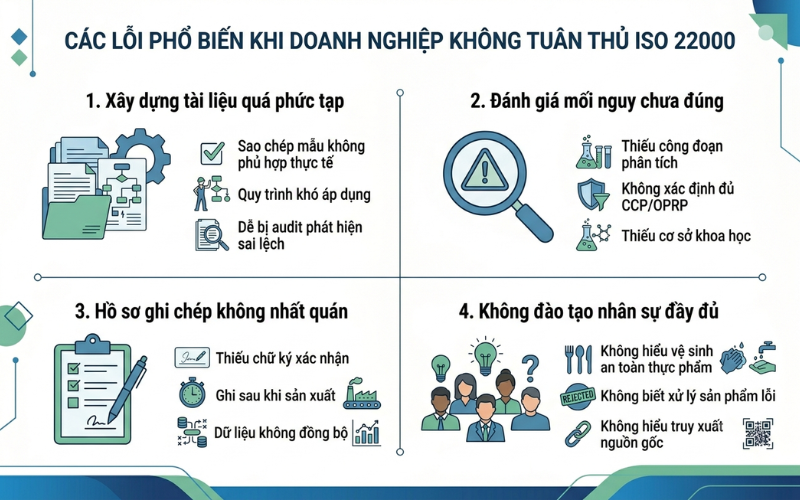
Businesses Not Complying with the ISO 22000 Certification Process
✔️ Building Overly Complex Documentation
Many businesses copy template documents, resulting in:
- Procedures that do not reflect actual operations.
- Difficulty for employees in applying them.
- Easy detection of inconsistencies during audits.
✔️ Incorrect Hazard Analysis
Common errors include:
- Missing certain process stages in the analysis.
- Failure to properly identify CCPs and OPRPs.
- Lack of scientific justification.
This is a critical group of errors as it directly impacts food safety.
✔️ Inconsistent Record-Keeping
Examples:
- Missing approval signatures.
- Records completed after production.
- Data inconsistencies between departments.
Auditors often perform cross-checking to detect these issues.
✔️ Insufficient Employee Training
Employees:
- Do not understand sanitation procedures.
- Do not know how to handle defective products.
- Do not understand traceability requirements.
This causes the system to lose effectiveness even if documentation is complete.
4. Guidance for Proper Implementation of the ISO 22000 Certification Process
Step 1: Assess the Current State of the Business
Businesses need to evaluate:
- Facility conditions.
- Production processes.
- Existing documentation systems.
- Level of compliance with the standard.
This step helps identify the gap that needs improvement.
Step 2: Develop the ISO 22000 Documentation System
Includes:
- Food safety policy.
- Food safety objectives.
- Operational procedures.
- Control forms and templates.
- Incident handling procedures.
Documentation must be:
- Realistic.
- Easy to apply.
- Easy to control.
Step 3: Training and Practical Implementation
Businesses should:
- Conduct ISO 22000 awareness training.
- Provide HACCP training.
- Guide record-keeping practices.
- Practice handling real scenarios.
This is a critical stage determining system effectiveness.
Step 4: Operation and Record Maintenance
Typically, the system should be operated for 2–3 months before the certification audit.
Key records include:
- Sanitation logs.
- Temperature control records.
- CCP/OPRP records.
- Raw material inspection records.
- Product traceability records.
Step 5: Internal Audit and Management Review
Businesses must:
- Conduct internal audits.
- Address nonconformities.
- Evaluate system effectiveness.
- Hold management review meetings.
This is a mandatory requirement before certification.
Step 6: ISO 22000 Certification Audit
Typically includes two stages:
Stage 1
Assessment of:
- System documentation.
- Level of readiness.
- Basic compliance conditions.
Stage 2
Assessment of:
- Production site conditions.
- Actual operational records.
- Effectiveness of system implementation.
If requirements are met, the organization will be granted ISO 22000 certification.
5. Practical Checklist Before ISO 22000 Audit
Documentation Checklist
- Food safety policy and objectives are available.
- Document control procedures exist.
- HACCP hazard analysis is completed.
- CCP/OPRP records are available.
- Traceability and recall plans are in place.
Facility Checklist
- Facility hygiene is ensured.
- Equipment is properly controlled.
- Personnel comply with hygiene practices.
- Cross-contamination prevention measures are implemented.
- Pest control is in place.
Operational Checklist
- Records are complete and consistent.
- Training evidence is available.
- Corrective actions are documented.
- Internal audit has been conducted.
- Management review has been performed.
6. Benefits of Achieving ISO 22000 Certification
Proper implementation of the ISO 22000 certification process brings many benefits:
Operational Benefits
- Reduced food safety risks.
- Standardized production processes.
- Reduced errors and waste.
- Improved internal control efficiency.
Commercial Benefits
- Enhanced brand reputation.
- Meeting customer and partner requirements.
- Easier access to export markets.
- Increased competitiveness.
Legal Benefits
- Supports compliance with food safety regulations.
- Reduces risk of violations and product recalls.
- Improves readiness for inspections and audits.
Understanding the ISO 22000 certification process helps businesses proactively build a suitable system, reduce audit errors, and optimize certification time.
The key is not “completing documentation,” but building a truly effective food safety management system that works in practice.
When implemented correctly from the beginning, businesses not only achieve certification faster but also significantly improve management capability, product quality, and market reputation.
Need support for end-to-end ISO 22000 certification implementation?
Contact NAPHA to receive expert assistance:
- Free initial assessment.
- Customized implementation roadmap.
- Training and documentation support.
- Full support throughout the ISO 22000 certification audit process.
CONTACT FOR FREE CONSULTING VIA HOTLINE: 0938.161.564
NAPHA CONSULTING CO., LTD
Địa chỉ: 3 Floor, An Phu Plaza, 117 - 119 Ly Chinh Thang Street, District 3, HCMC
Email: tuvannapha@gmail.com


main.comment_read_more