





ISO 22000 FOR INDUSTRIAL CATERING KITCHENS
In the industrial catering sector, even a minor mistake in food safety control can lead to serious consequences such as mass food poisoning, production disruptions, or direct impacts on a company's reputation.
However, in practice, many businesses still implement ISO 22000 incorrectly, resulting in systems that are cumbersome, difficult to apply, or time-consuming while still facing challenges in obtaining certification.
This is why an increasing number of organizations are interested in implementing ISO 22000 for industrial catering kitchens to standardize their food safety management systems and enhance operational capabilities.
1. What is ISO 22000 for industrial catering kitchens?
ISO 22000 is an international standard for Food Safety Management Systems (FSMS) that applies to the entire food supply chain, including:
- Industrial catering kitchens
- Factory canteens
- School cafeterias
- Hospitals
- Industrial meal providers
- Catering and food service businesses
This standard enables organizations to systematically control food safety hazards throughout the entire process, from raw material procurement to the delivery of final meals.
For industrial catering kitchens, ISO 22000 plays a particularly important role due to:
- The large volume of meals prepared daily
- Continuous food preparation processes
- Multiple stages where cross-contamination can occur
- Increasingly stringent regulatory requirements
2. Common challenges faced by industrial catering kitchen businesses
✔️Inadequate control of raw materials
Many businesses have not established a systematic supplier evaluation process, resulting in:
- Lack of traceability documentation
- Inconsistent raw material quality
- Insufficient incoming inspection procedures
These issues increase the risk of food safety incidents from the very first stage of the process.
✔️Inconsistent operational processes
Some industrial kitchens still rely heavily on individual experience rather than standardized procedures, leading to:
- Improper temperature control
- Lack of sample retention procedures
- Poor separation between clean and contaminated areas
- Non-standardized sanitation practices
As meal production volumes increase, these shortcomings can result in significant food safety risks.
✔️ISO documentation used only for compliance purposes
Many organizations develop ISO systems that are overly focused on documentation, including:
- Complex forms and records
- Employees who do not fully understand the procedures
- Documentation practices that do not reflect actual operations
As a result, the management system exists on paper but fails to function effectively in practice.
✔️Poor control of food safety hazards
This is one of the primary causes of:
- Food poisoning incidents
- Customer complaints
- Non-compliance with legal and regulatory requirements
- Damage to the organization's reputation
3. Expert perspective: The true essence of ISO 22000 for industrial catering kitchens
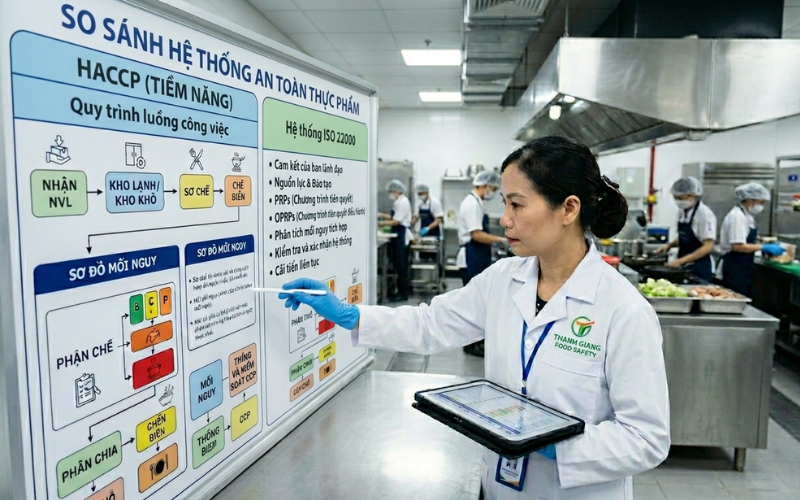
Expert perspective: The true essence of ISO 22000 for industrial catering kitchens
Many businesses view ISO 22000 for industrial catering kitchens merely as a certification required for tender participation or to satisfy customer requirements. In reality, the true purpose of this standard is to establish an effective and sustainable food safety risk management system.
✔️Systematic hazard control
ISO 22000 requires organizations to identify and control all food safety hazards, including:
- Biological hazards
- Chemical hazards
- Physical hazards
- Food allergens
Across the entire operational chain:
- Raw material receiving
- Storage
- Preparation
- Cooking and processing
- Portioning
- Transportation
- Meal serving
✔️Integration of HACCP and operational management
ISO 22000 focuses not only on food hygiene but also on comprehensive management of:
- Personnel
- Documented information
- Internal audits
- Traceability
- Incident management
- Continual improvement
✔️The system must be practical and easy to implement
An effective ISO system does not require excessive paperwork. Instead, it should be:
- Easy to understand
- Easy to implement
- Suitable for the kitchen's operating model
- Practical for employees to follow on a daily basis
✔️Common implementation ,istakes
- Copying template documents
This is one of the most common mistakes when implementing ISO 22000 for industrial catering kitchens.
Many businesses use generic templates without adapting them to their actual operations, resulting in:
- Inappropriate procedures
- Difficult implementation by employees
- Records that do not reflect actual practices
✔️Incorrect CCP and OPRP analysis
Organizations often confuse:
- CCP (Critical Control Point)
- OPRP (Operational Prerequisite Program)
This can cause the food safety system to focus on the wrong control measures and lead to nonconformities during audits.
✔️ Ineffective employee training
Some organizations conduct training merely as a formality:
- Employees do not understand why compliance is necessary
- Food safety risks are not properly recognized
- Staff only comply during audits
In reality, people are the most critical factor in determining the effectiveness of the system.
✔️Failure to maintain the system after certification
After obtaining certification, many businesses:
- Stop updating records
- Neglect internal audits
- Fail to improve operational processes
As a result, the management system gradually loses its effectiveness.
4. Implementation Guide for ISO 22000 in Industrial Catering Kitchens
Step 1: Conduct an initial assessment
Organizations should evaluate:
- Infrastructure
- Equipment
- Food preparation processes
- Hygiene conditions
- Legal compliance documentation
- Employee competence
The objective is to identify gaps between current practices and ISO 22000 requirements.
Step 2: Establish prerequisite programs (PRPs)
PRPs form the foundation of the ISO 22000 system and include:
- Facility sanitation
- Pest control
- Equipment cleaning and sanitation
- Water quality control
- Waste management
- Personal hygiene
- Equipment maintenance
Without effective PRP controls, the HACCP system cannot function efficiently.
Step 3: Conduct hazard analysis and develop HACCP plans
This is the core element of ISO 22000.
Organizations should:
- Identify hazards
- Assess risks
- Determine control measures
- Establish CCPs and OPRPs
The analysis must be based on actual industrial kitchen operations.
Step 4: Standardize operating procedures
Develop clear and practical SOPs, including:
- Food preparation SOPs
- Cleaning and sanitation SOPs
- Food sample retention SOPs
- Temperature monitoring SOPs
- Meal delivery and receiving SOPs
Procedures should be concise, clear, and easy to follow.
Step 5: Train employees
Training should focus on practical application, including:
- Personal hygiene
- Cross-contamination prevention
- Temperature control
- Record keeping
- Food safety incident response
Step 6: Conduct internal audits and corrective actions
Before certification audits, organizations should:
- Perform internal audits
- Address nonconformities
- Complete required documentation
- Verify operational effectiveness
Step 7: Apply for ISO 22000 certification
Select an appropriate certification body to conduct:
- Stage 1 audit
- Stage 2 audit
- ISO 22000 certification issuance
5. ISO 22000 Checklist for Industrial Catering Kitchens
Facility Checklist
- Clear separation of clean and contaminated areas
- Effective pest control system
- Suitable drainage system
- Hygienic equipment and facilities
Operational Checklist
- Cold storage temperature monitoring
- Cooking temperature monitoring
- Proper food sample retention
- Meal delivery time control
Documentation Checklist
- Raw material receiving records
- Cleaning and sanitation records
- Training records
- Equipment calibration records
- Traceability records
Personnel Checklist
- Periodic health examinations
- Adequate food safety training
- Compliance with protective clothing requirements
- Proper personal hygiene practices
Internal Audit Checklist
- Scheduled internal audit program
- Corrective action implementation
- Monitoring of continual improvement activities
6. Benefits of Implementing ISO 22000 for Industrial Catering Kitchens
Enhanced Business Reputation
ISO 22000 helps build trust with:
- Customers
- Business partners
- Investors and project owners
- Regulatory authorities
Reduced Legal Risks
A well-controlled system helps organizations:
- Reduce the risk of food poisoning incidents
- Minimize food safety violations
- Lower the risk of penalties and sanctions
Improved Operational Efficiency
Organizations can:
- Standardize processes
- Reduce operational errors
- Minimize waste and losses
- Improve workforce productivity
Many large clients require catering service providers to hold ISO 22000 or HACCP certification as a prerequisite for cooperation.
Implementing ISO 22000 for industrial catering kitchens is not only about obtaining certification but also about establishing a structured, reliable, and sustainable food safety management system.
When implemented correctly, organizations can:
- Effectively control food safety risks
- Reduce operational incidents
- Optimize business processes
- Strengthen brand reputation
- Increase competitive advantage in the market
Most importantly, the system should be designed to reflect actual operational practices rather than focusing solely on documentation.
Need professional consulting and certification support for ISO 22000 implementation in your industrial catering kitchen?
Contact NAPHA today to receive expert guidance, a tailored implementation roadmap, and hands-on support throughout the entire process until certification is achieved.
CONTACT FOR FREE CONSULTING VIA HOTLINE: 0938.161.564
NAPHA CONSULTING CO., LTD
Địa chỉ: 3 Floor, An Phu Plaza, 117 - 119 Ly Chinh Thang Street, District 3, HCMC
Email: tuvannapha@gmail.com


main.comment_read_more