





EFFECTIVE ISO 9001 IMPLEMENTATION PROCESS IN ENTERPRISES FROM A TO Z
In an increasingly competitive business environment, establishing a well-structured quality management system is no longer an option but has become a mandatory requirement for many organizations. Today, many businesses are focusing on the ISO 9001 implementation process to standardize operations, improve product quality, and optimize management efficiency.
So, how does the ISO 9001 implementation process work? What should organizations prepare to ensure successful implementation? The article below will help you gain a comprehensive understanding of the entire process from the practical perspective of ISO implementation experts.
What Is ISO 9001?
ISO 9001 is an international standard for Quality Management Systems (QMS), widely applied by organizations around the world. The standard helps businesses establish systematic workflows, control operational risks, and drive continual improvement in order to enhance the quality of products and services.
The most widely adopted version today is ISO 9001:2015, which emphasizes risk-based thinking and continual improvement. It also serves as a critical foundation in the ISO 9001 implementation process for most organizations today.
Why Do Businesses Need to Implement ISO 9001?
Implementing an effective ISO 9001 system provides many practical benefits, including:
- Standardizing internal operational processes
- Improving management efficiency
- Enhancing corporate image and credibility
- Increasing customer satisfaction
- Facilitating participation in tenders and market expansion
- Strengthening competitive advantage
- Creating a foundation for digital transformation and ESG initiatives
I. ISO 9001 Implementation Process in Enterprises
Below is the standard ISO 9001 implementation process commonly applied in most organizations today.
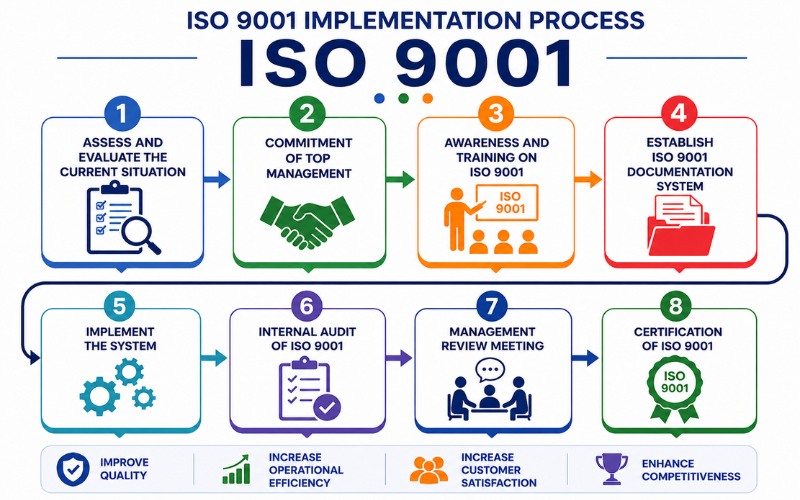
ISO 9001 Implementation Process
Step 1: Initial Survey and Gap Assessment
In the ISO 9001 implementation process, this is the first and one of the most critical stages.
The organization should assess:
- Current organizational structure
- Existing operational processes
- Current documentation and records
- Nonconformities against ISO 9001 requirements
- Operational risks and weaknesses
The objective of this stage is to identify the gap between the current management system and ISO 9001 requirements.
Expected Outputs:
- Gap assessment report
- ISO implementation plan
- Defined scope of certification
Step 2: Top Management Commitment
A successful ISO 9001 implementation process cannot be achieved without strong commitment from top management.
Top management should:
- Define quality objectives
- Allocate necessary resources
- Establish the ISO implementation team
- Promote internal communication
- Drive continual improvement initiatives
In practice, leadership commitment accounts for more than 50% of the success of an ISO project.
Step 3: ISO 9001 Awareness Training
Training is an essential part of the ISO 9001 implementation process.
Organizations should provide training on:
- ISO 9001 awareness
- Process-based management thinking
- Risk management
- Documentation and record control
- Internal audit skills
Training helps employees understand that ISO is not merely about paperwork, but rather a management tool that improves operational efficiency.
Step 4: Development of the ISO 9001 Documentation System
At this stage of the ISO 9001 implementation process, the organization standardizes its operational processes.
The documentation system typically includes:
- Quality Policy
- Quality Objectives
- ISO procedures
- Work instructions
- Forms and templates
- Documented information and record control procedures
An effective documentation system should be easy to understand, practical to implement, aligned with actual operations, and not unnecessarily complicated.
Step 5: Practical Implementation
After the documentation is issued, the organization proceeds with practical implementation in daily operations. This is the most critical stage in the entire ISO 9001 implementation process.
This phase allows the organization to “test-run” the ISO system before the certification audit.
Step 6: Internal Audit
As part of the ISO 9001 implementation process, organizations are required to conduct internal audits in order to:
- Verify system compliance
- Identify nonconformities
- Implement corrective actions
- Improve system effectiveness
This activity is typically conducted by trained internal auditors.
Step 7: Management Review Meeting
Following the internal audit, top management reviews:
- Effectiveness of the ISO management system
- KPI achievement results
- Customer feedback
- Emerging risks and issues
- Opportunities for improvement
This is a mandatory requirement under ISO 9001:2015 and an important step in the ISO 9001 implementation process.
Step 8: ISO 9001 Certification Audit
The final step in the ISO 9001 implementation process is the certification audit.
The organization selects an accredited certification body to conduct the audit process.
The certification audit generally consists of:
- Stage 1 Audit: Documentation review
- Stage 2 Audit: On-site implementation audit
If all requirements are satisfactorily met, the organization will be granted the ISO 9001 certification.
II. Best Practices for Successful ISO 9001 Implementation
Below are some practical recommendations to optimize the ISO 9001 implementation process.
1. Avoid Copying Documentation
Each organization operates differently; therefore, the ISO system should be customized to fit actual business operations.
2. Focus on Core Processes
There is no need to create an excessive number of complicated procedures at the initial stage.
3. Integrate Digital Transformation
Organizations may integrate tools such as:
- ERP systems
- Workflow systems
- E-Office platforms
- KPI dashboards
to digitalize the ISO management system.
4. Maintain Continual Improvement
ISO should not be treated as a short-term project, but rather as a long-term management system.
III. Conclusion
Establishing and properly implementing the ISO 9001 system not only helps organizations obtain certification, but also creates a professional management foundation that enhances operational efficiency and supports sustainable development.
A well-structured ISO 9001 implementation process helps organizations:
- Optimize operational processes
- Reduce operating costs
- Improve product and service quality
- Strengthen competitiveness
- Enhance international integration readiness
If your organization is currently working toward management system standardization, ISO 9001 is an essential starting point for long-term sustainable growth.
Contact Napha Consulting today to receive direct support from experienced consultants in assessing your current system and assisting your organization in achieving ISO 9001 certification efficiently and effectively.
Napha Consulting – Accompanying businesses toward quality excellence and sustainable development.
CONTACT FOR FREE CONSULTING VIA HOTLINE: 0938.161.564
NAPHA CONSULTING CO., LTD
Địa chỉ: 3 Floor, An Phu Plaza, 117 - 119 Ly Chinh Thang Street, District 3, HCMC
Email: tuvannapha@gmail.com


main.comment_read_more