





WHAT CLAUSES ARE INCLUDED IN ISO 22000:2018?
In the food industry, ISO 22000 is not merely a certification; it is an international standard that establishes a comprehensive Food Safety Management System (FSMS). By integrating systematic management principles with hazard control methodologies (HACCP), understanding the structure of ISO 22000:2018 enables businesses to build a robust “shield” for consumer health protection and brand reputation enhancement.
This article provides an in-depth analysis of the 10 core clauses of ISO 22000:2018, highlights common implementation mistakes, and outlines an effective roadmap for successful system deployment.
1. Overview: Common “Bottlenecks” Faced by Businesses
Most organizations encounter several common challenges when first approaching ISO 22000:
- Superficial implementation: Treating the standard merely as documentation for audits or customer requirements rather than as a practical management tool.
- Confusion between ISO 22000 and HACCP: Resulting in systems that focus solely on hazard control while neglecting broader management aspects such as leadership, organizational context, and continual improvement.
- Overly complicated systems: Establishing excessive procedures that are impractical to operate, leading to inefficient resource utilization.
2. Expert Perspective: Understanding the Core Structure of ISO 22000:2018
ISO 22000:2018 is developed based on the High-Level Structure (HLS), enabling seamless integration with other management systems such as ISO 9001 and ISO 27001.
The standard fundamentally operates on the PDCA cycle (Plan – Do – Check – Act) across two levels:
- Organizational management
- Operational control (HACCP)
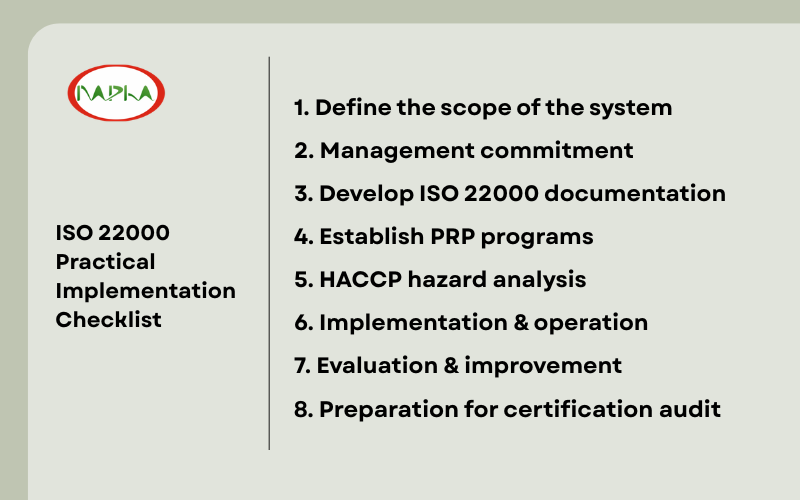
ISO 22000 Practical Implementation Checklist
Detailed Breakdown of the 10 Main Clauses
- Clauses 1, 2, and 3: Scope, normative references, and terms & definitions.
- Clause 4 – Context of the Organization: Identifying internal and external factors affecting food safety.
- Clause 5 – Leadership: Top management commitment serves as the “heart” of the system.
- Clause 6 – Planning: Identifying risks and opportunities while establishing food safety objectives.
- Clause 7 – Support: Managing resources, personnel competence, and documented information.
- Clause 8 – Operation: This is the most critical clause, covering:
- PRPs (Prerequisite Programs)
- Traceability systems
- Hazard control based on HACCP principles
- Clause 9 – Performance Evaluation: Monitoring, measurement, analysis, and internal audits.
- Clause 10 – Improvement: Handling nonconformities and implementing corrective actions.
3. Common Practical Mistakes Made by Businesses
Based on our experience in consulting and auditing ISO 22000:2018, we have identified the following common nonconformities:
- Inadequate hazard analysis: Failure to comprehensively assess chemical, physical, or biological hazards specific to raw materials.
- Neglecting organizational context: Lack of clarity regarding the needs and expectations of interested parties, including updated food safety regulations.
- Disconnected traceability systems: Inability to demonstrate product flow from incoming materials to finished goods within 24 hours during incident investigations.
4. Step-by-Step Implementation Guidance
To achieve meaningful certification outcomes, businesses should follow a structured implementation roadmap:
Step 1: Initial Assessment & Awareness Training: Ensure employees fully understand the structure of ISO 22000:2018 and their individual responsibilities.
Step 2: Establish the Food Safety Team: Select members with strong technical expertise and production process knowledge.
Step 3: Develop the Documentation System: Draft procedures aligned with actual operational practices instead of copying generic templates.
Step 4: System Implementation & Operation: Implement PRPs, OPRPs, and CCP controls throughout production operations.
Step 5: Internal Audit & Corrective Action: Conduct internal assessments to identify weaknesses before engaging a certification body.
5. Practical ISO 22000:2018 Implementation Checklist
1. Define the Scope of the System
- Define products and certification scope
- Identify implementation locations
- Determine production, processing, and storage activities
- Identify applicable food safety legal requirements
- Identify interested parties (customers, authorities, suppliers, etc.)
2. Leadership Commitment
- Establish a food safety policy
- Define food safety objectives
- Assign responsibilities and authorities
- Establish the HACCP/Food Safety Team
- Allocate implementation resources
3. ISO 22000 Documentation Development
- Food Safety Manual (if applicable)
- Document control procedure
- Record control procedure
- Traceability procedure
- Product recall procedure
- Nonconforming product control procedure
- Internal audit procedure
- Corrective action procedure
4. Establish PRP Programs
- Facility hygiene control
- Pest control
- Water source management
- Personnel hygiene control
- Waste management
- Equipment maintenance control
- Supplier management
- Incoming material control
- Storage and transportation control
5. HACCP Hazard Analysis
- Product description
- Intended use identification
- Process flow diagram establishment
- On-site verification of process flow
- Biological hazard identification
- Chemical hazard identification
- Physical hazard identification
- Risk assessment
- CCP/OPRP determination
- Establishment of critical limits
- Monitoring activities
- Corrective actions
6. Implementation & Operation
- ISO 22000 awareness training
- HACCP training for relevant personnel
- Recordkeeping implementation
- SOP-based operational control
- On-site compliance inspections
- Verification of hazard control effectiveness
7. Evaluation & Improvement
- Conduct internal audits
- Correct nonconformities
- Management review meetings
- Periodic supplier evaluations
- Update emerging risks and hazards
- Continual improvement of the FSMS
8. Certification Audit Preparation
- Complete ISO 22000 documentation
- Maintain at least 2–3 months of operational records
- Conduct comprehensive internal audits
- Prepare management review records
- Close all internal nonconformities
- Prepare for certification body assessments
Important Records Commonly Missing
- Traceability records
- Equipment calibration records
- CCP/OPRP monitoring records
- Personnel training records
- Supplier evaluation records
- Cleaning and pest control records
- Nonconforming product handling records
6. Operational Benefits and Legal Value
- Proper implementation of ISO 22000:2018 delivers dual value to organizations:
Legal Benefits: Ensures compliance with increasingly stringent regulatory requirements related to food safety management and HACCP implementation.
Operational Benefits:
- Reduces product defect rates
- Minimizes incident handling costs
- Enhances brand reputation in international markets
Implementing ISO 22000 should not be viewed merely as obtaining a certificate; it is about establishing a sustainable food safety culture throughout the organization.
Is your business facing challenges in understanding ISO 22000 clauses or seeking an optimized certification roadmap?
Contact Napha Consulting today to receive direct assessment and professional support from our experienced experts, helping your organization achieve ISO 22000:2018 certification in the most efficient and timely manner.
Napha Consulting – Accompanying Businesses Toward Quality Excellence and Sustainable Development.
CONTACT FOR FREE CONSULTING VIA HOTLINE: 0938.161.564
NAPHA CONSULTING CO., LTD
Địa chỉ: 3 Floor, An Phu Plaza, 117 - 119 Ly Chinh Thang Street, District 3, HCMC
Email: tuvannapha@gmail.com


main.comment_read_more