





WHAT IS FSC?
FSC (Forest Stewardship Council) is the Forest Stewardship Council, established in 1993 as an independent, non-governmental, non-profit organization. Its mission is to promote responsible and sustainable forest management worldwide through clear standards and credible certification schemes.
Since its establishment, FSC has demonstrated a strong global impact in preventing illegal logging and severe forest degradation.
Forest Management (FM) certification, also known as sustainable forest management certification or forest certification, is a process whereby forest management organizations are assessed by an independent third-party certification body against established forest management standards.
Based on internationally recognized principles and criteria, FM certification demonstrates that forest management practices meet the requirements of environmentally appropriate, socially beneficial, and economically viable forest management.
TYPES OF FSC CERTIFICATION
FSC certification, often referred to as timber certification, is a market-based tool designed to promote sustainable forest management and achieve ecological, social, and economic objectives.
The FSC certification system includes:
- Forest Management (FM) certification – applicable to forest owners and managers
- Chain of Custody (CoC) certification – applicable to organizations involved in processing, manufacturing, trading, and distributing FSC-certified forest products
These certifications enable organizations to demonstrate responsible sourcing and management of forest products in line with the principles of the Forest Stewardship Council (FSC).
FSC forest certification schemes are widely supported and evaluated by environmental non-governmental organizations (NGOs) and civil society organizations, reinforcing their credibility and transparency.
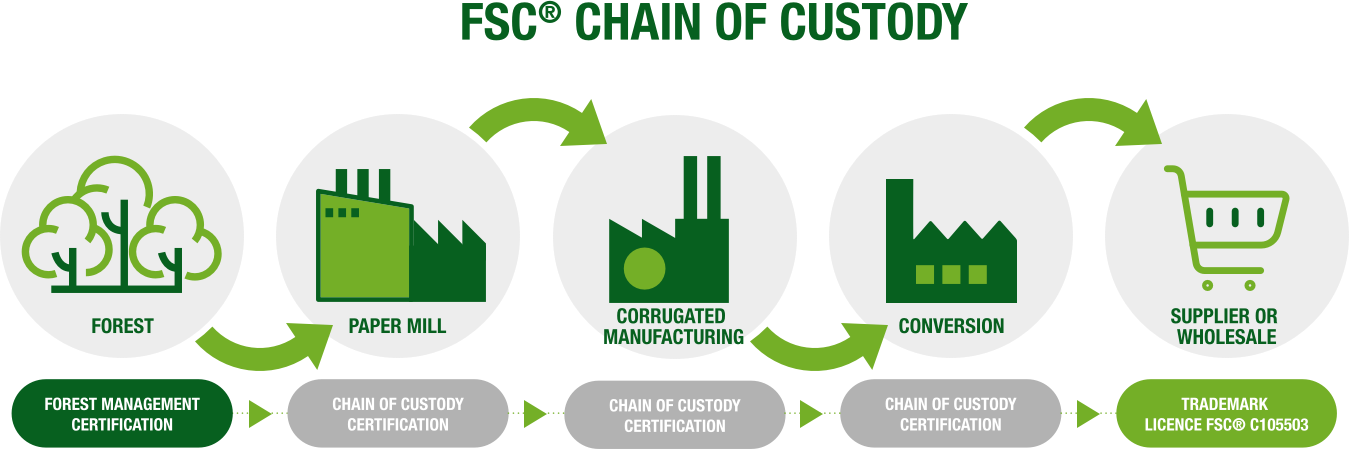
FSC Certification - Forest Management & Chain of Custody Certification
1. FSC-FM (FSC Forest Management)
This certification is specifically intended for forest owners and forest management organizations involved in forest planting and harvesting activities. Obtaining FSC-FM certification means that the entire forest area or the registered forest management unit is certified under the FSC scheme.
FSC-FM certification provides evidence that forest management operations comply with the 10 FSC Principles, ensuring that forest management practices meet environmental, economic, and social sustainability requirements in accordance with FSC standards.
2. FSC CoC (Chain of Custody)
FSC Chain of Custody (CoC) certification applies to the entire product supply chain, covering the management and traceability of wood-based materials from the certified forest to the final consumer. This chain includes consecutive stages such as processing, transportation, manufacturing, and distribution.
Chain of Custody is the system used to identify and track timber originating from FSC-certified forests through each stage of production until the product is labelled and sold. The establishment of an FSC CoC system ensures that all wood sourced from approved forests is controlled and traceable from forest → factory → end user, and is clearly segregated from non-approved or non-certified wood.
The FSC label enables end consumers to recognize FSC-certified products and actively support responsible and sustainable forest management.
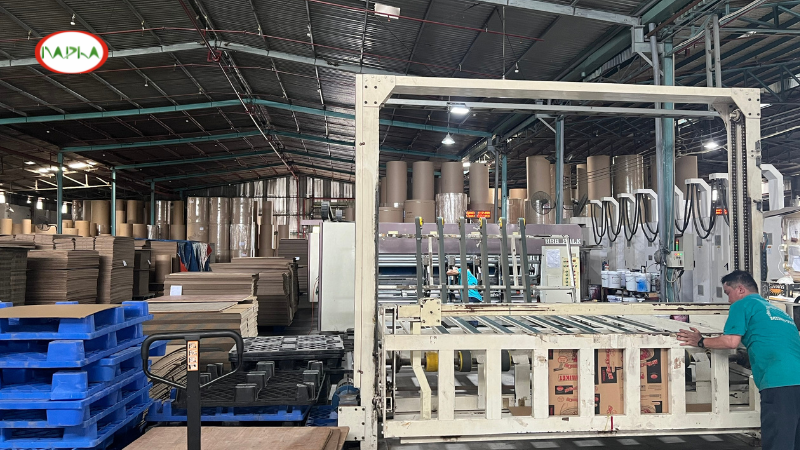
Napha provided FSC-CoC certification consulting services to Minh Phuc Packaging Company.
3. FSC-CW (Controlled Wood)
FSC Controlled Wood (FSC-CW) certification is a management system certification applicable to forest managers, manufacturers, processors, and traders that source, process, or trade wood in accordance with FSC Controlled Wood requirements.
Controlled Wood refers to wood material that is acceptable under FSC rules, provided it does not originate from the five categories of unacceptable sources defined by FSC. Wood that meets these requirements may be used in FSC-certified supply chains and may be associated with FSC claims in accordance with applicable FSC standards.
FSC Controlled Wood certification helps organizations manage sourcing risks and ensure that their wood materials meet FSC’s minimum requirements for responsible forest management.
FSC CERTIFICATION STANDARDS AND GUIDANCE DOCUMENTS
The FSC certification system, developed by the Forest Stewardship Council (FSC), is supported by a comprehensive set of standards, policies, and guidance documents, including:
- FSC-STD-40-004 (Version 3.0) – FSC Chain of Custody (CoC) Certification Standard
- FSC-STD-40-004a (Version 2.0) – FSC Product Classification
- FSC-STD-50-001 (Version 2.0) – Trademark Use Requirements for FSC Certificate Holders
- FSC-DIR-40-004 – FSC Directive on Chain of Custody Certification
- FSC-STD-40-003 (Version 2.1) – Multi-site Chain of Custody Certification Standard
- FSC-POL-01-004 – FSC Policy for Association
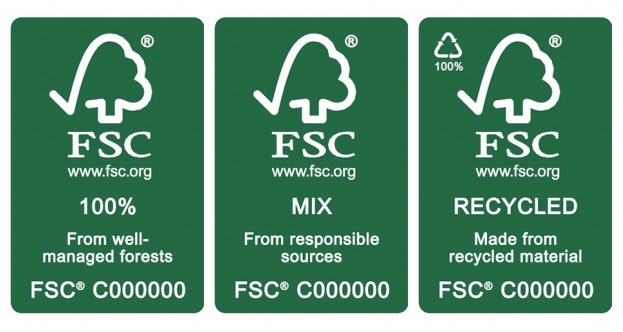
FSC certifications
WHICH ORGANIZATIONS REQUIRE FSC CoC CERTIFICATION?
The industries listed below are strongly recommended—or required by customer demands and importing country regulations—to obtain FSC Chain of Custody (CoC) certification:
- Forestry enterprises: State-owned forest farms, corporate forest plantations, community forests, private forest owners, and all other forestry operations.
- Forest product trading companies: International trading companies and sales organizations involved in forest and timber products.
- Enterprises directly or indirectly involved in forest product processing, such as log processing mills, panel and board factories, furniture manufacturing plants, flooring factories, door and window manufacturers, pulp mills, paper mills, packaging plants, and printing facilities, etc.
- Businesses associated with wood-based products, including the flooring industry, furniture manufacturing, interior decoration, musical instrument manufacturing, stationery, toys, gifts, packaging, and printing industries.
THE ROLE OF FSC FOREST CERTIFICATION
When discussing FSC certification, the following key aspects should be considered:
- Environmental impact
- Economic effectiveness
- Social impact
WHAT IS THE ROLE OF FSC FOREST CERTIFICATION?
- FSC is a stakeholder-owned system established to promote responsible forest management worldwide.
- FSC authorizes independent third-party certification bodies to certify forest management units and forest product companies against FSC standards.
- The FSC brand provides international recognition for certified organizations and supports the global expansion of responsible forest management practices.
- FSC product labels enable consumers worldwide to easily identify products that support responsible and sustainable forest management.
- In summary, FSC forest certification is highly suitable for forestry operations and forest-based enterprises. However, certification suitability should always be evaluated comprehensively, taking into account the organization’s operational scope, conditions, and business objectives.
FSC-CERTIFIED PRODUCTS AND FSC LABELS
Products that are FSC certified are eligible to carry the FSC label, which indicates the origin and composition of the raw materials used. The main FSC label types include:
- FSC 100%: All raw materials used in the product originate from FSC-certified forests. Label text: “[Product type] from well-managed forests.”
- FSC MIX: “Mixed” means that at least 70% of the wood in the product comes from FSC-certified and/or recycled materials, while up to 30% comes from controlled wood. Label text: “[Product type] from responsible sources.”
- FSC RECYCLED: The wood or paper used in the product is made entirely from recycled materials. Label text: “[Product type] made from recycled material.”
THE 10 PRINCIPLES OF THE FSC / CoC STANDARD
- Principle 1: Compliance with Laws and FSC Principles
Forest management shall comply with all applicable laws and national regulations, as well as international treaties, conventions, and agreements ratified by the country, and shall conform to all principles and criteria established by the Forest Stewardship Council (FSC).
- Principle 2: Tenure and Use Rights and Responsibilities
Long-term land tenure, use rights, and responsibilities related to land and forest resources shall be clearly defined, documented, and legally established. Forest management organizations must maintain appropriate records and legal documentation (including foreign or statutory land-use certificates, where applicable) to demonstrate legitimate ownership, use rights, and management responsibilities.
- Principle 3: Indigenous Peoples’ Rights
Forest management shall recognize and respect the legal and customary rights of Indigenous and local communities to own, use, and manage their lands, territories, and resources.
- Principle 4: Community Relations and Workers’ Rights
Forest management activities shall maintain or enhance the long-term social and economic well-being of forest workers and local communities, including employment, livelihoods, and social benefits.
- Principle 5: Benefits from the Forest
Forest management shall encourage the efficient use of the forest’s multiple products and services in order to ensure economic viability, while delivering social and environmental benefits from the forest.
- Principle 6: Environmental Impact
Forest management shall conserve biological diversity and its associated values, including water and soil resources, as well as unique and fragile ecosystems and landscapes, in order to maintain the ecological functions and integrity of forest ecosystems.
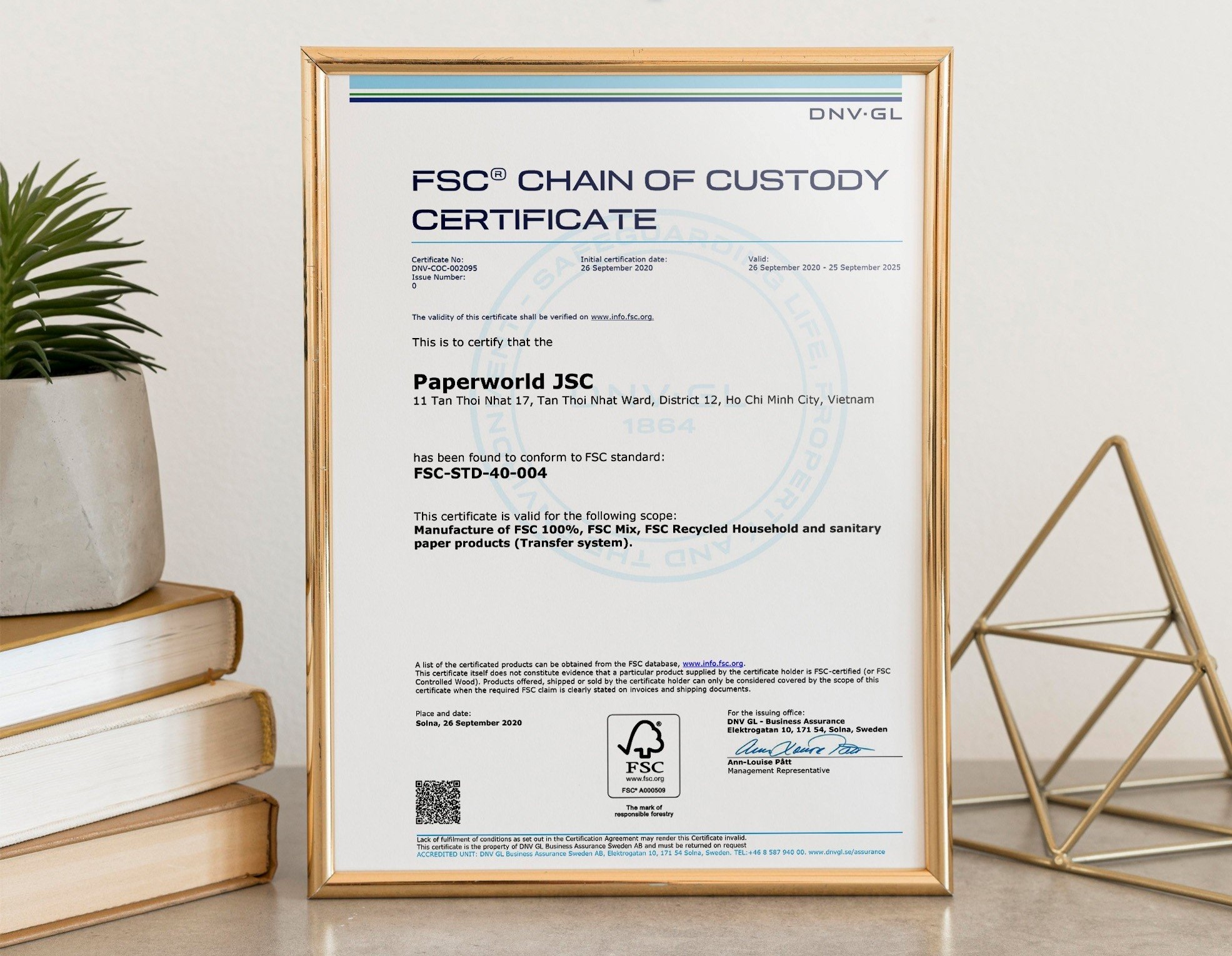
Sample FSC COC certificate
- Principle 7: Management Planning
A forest management plan, appropriate to the scale and intensity of operations, shall be developed, implemented, and regularly updated. The plan shall clearly define the long-term management objectives and the means of achieving those objectives.
- Principle 8: Monitoring and Assessment
Monitoring and assessment shall be conducted in accordance with the scale and intensity of forest management to evaluate forest conditions, yields of forest products, chain of production and marketing activities, management activities, and their social and environmental impacts.
- Principle 9: High Conservation Value Forests (HCVFs)
Management activities in forests with High Conservation Value shall maintain or enhance the attributes that define such forests. Decisions regarding these forests shall be made using a precautionary approach and supported by appropriate conservation policies.
- Principle 10: Plantations
Plantations shall be planned and managed in accordance with Principles 1–9 and this Principle. Plantation management shall generate a range of social and economic benefits and contribute to meeting the market demand for forest products. At the same time, plantations shall complement natural forests, reduce pressure on natural forest exploitation, and promote the conservation and restoration of natural forests.
FSC CERTIFICATION IMPLEMENTATION PROCESS
1. Client Information Submission for Quotation
In accordance with the requirements of Forest Stewardship Council (FSC), forest management units, wood processing companies (including products such as pulp, paper, printing paper, packaging, stationery, gifts, furniture, interior decoration, etc.), or trading companies wishing to apply for FSC certification are required to submit initial information.
A preliminary assessment will be conducted based on the company’s basic documents in order to develop an appropriate FSC certification plan.
2. Contract Signing
Based on the review of the preliminary information, the customer service team will proceed to sign a certification contract with the organization applying for FSC certification.
3. Consultancy and Training for Certification Preparation
The company will organize internal training programs, develop the required documentation system, and implement practices in compliance with FSC Principles and requirements.
Enterprises may engage an independent third-party FSC consultancy to provide professional advisory services, helping them prepare effectively and facilitate successful FSC certification.
4. Certification Audit
The certification audit is conducted according to the schedule arranged by the FSC-accredited certification body. The main audit scope includes:
- Product identification;
- Product segregation (certified and non-certified materials);
- Establishment and maintenance of records (including documented files);
- Staff training and awareness;
- Selection of the applicable control system;
- Product group determination;
- Correct use of the FSC trademarks and labels.
5. Certification Report
Based on the audit results, the certification body prepares an audit report. The report either confirms conformity or identifies non-conformities requiring corrective actions.
The report is then submitted to the certification decision committee for final review.
6. Certificate Issuance
If all requirements are satisfactorily met, the FSC certificate will be issued to the company. Where applicable, conditional requirements may be imposed and must be closed within a specified timeframe.
The use of the FSC certificate and registered FSC trademarks in the marketplace is subject to strict control and supervision in accordance with FSC rules.
7. Surveillance and Evaluation (Annual Audit)
At defined intervals, typically on an annual basis, an on-site surveillance audit will be conducted by qualified auditors. The purpose of this audit is to verify whether the conditions and requirements identified in the certification audit report are properly maintained and effectively implemented by the company.
Key aspects of the surveillance audit include the review of records and documentation, document access control, product control, and the correct use of FSC trademarks and labels in accordance with the requirements of Forest Stewardship Council (FSC).
CONTACT FOR FREE CONSULTING VIA HOTLINE: 0938.161.564
NAPHA CONSULTING CO., LTD
Địa chỉ: 3 Floor, An Phu Plaza, 117 - 119 Ly Chinh Thang Street, District 3, HCMC
Email: tuvannapha@gmail.com



main.comment_read_more