





7 QUALITY MANAGEMENT PRINCIPLES OF ISO 9001 FOR SUSTAINABLE BUSINESS DEVELOPMENT
In today’s increasingly competitive business environment, establishing an effective management system is no longer an option but a critical factor for organizational survival and long-term success. One of the most important foundations for achieving this is ISO 9001 — the internationally recognized standard for Quality Management Systems (QMS), widely adopted by organizations around the world.
ISO 9001 is an international standard for Quality Management Systems (QMS), widely applied worldwide. This standard helps organizations establish systematic workflows, control risks, and drive continual improvement to enhance the quality of products and services.
At the core of this standard are the 7 Quality Management Principles of ISO 9001. These principles serve as fundamental guidelines that help organizations improve operational performance, optimize quality, and increase customer satisfaction.
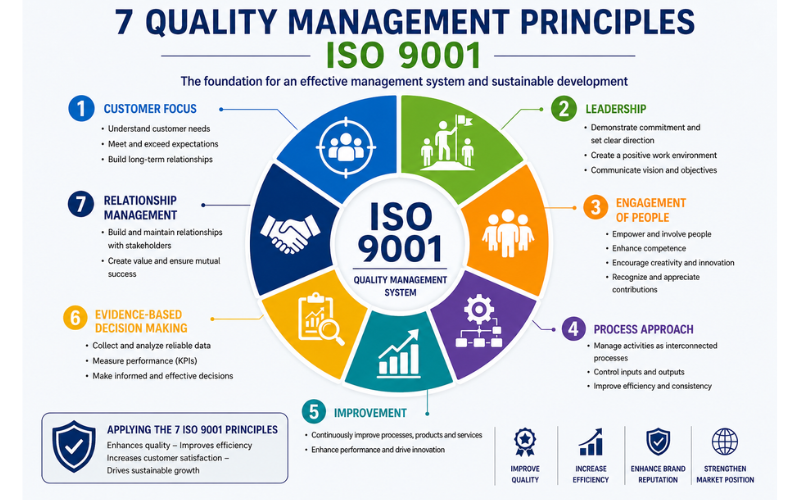
7 Quality Management Principles of ISO 9001
1. Customer Focus
The first and most essential principle of the 7 Quality Management Principles of ISO 9001 is customer focus. All organizational activities should aim to meet customer requirements and exceed customer expectations.
Organizations should:
- Listen to customer feedback
- Understand market demands
- Enhance customer experience
- Maintain long-term customer relationships
When customers are satisfied, organizations can strengthen brand reputation and achieve sustainable competitive advantages.
2. Leadership
Leadership plays a critical role in establishing organizational direction and creating alignment throughout the company. Effective leaders help define clear objectives while fostering a positive working environment for employees.
Within the 7 Quality Management Principles of ISO 9001, this principle emphasizes that:
- Top management should demonstrate strong commitment to quality
- A culture of continual improvement should be established
- Employees must clearly understand organizational objectives and responsibilities
Alignment from leadership levels contributes significantly to the effectiveness and stability of the management system.
3. Engagement of People
People at all levels are essential to the success of an organization. When employees are properly trained, recognized, and empowered, they contribute more effectively to organizational performance.
Organizations should:
- Encourage accountability
- Enhance competency through training
- Build a transparent working environment
- Recognize employee contributions
Among the 7 Quality Management Principles of ISO 9001, this principle forms the foundation for maximizing workforce capability and engagement.
4. Process Approach
Organizations operate more effectively and efficiently when activities are managed as interconnected processes rather than isolated tasks.
This principle helps organizations:
- Control inputs and outputs effectively
- Reduce operational errors
- Improve consistency in quality
- Optimize operational performance
Applying the process approach is a key element of the 7 Quality Management Principles of ISO 9001, enabling organizations to operate systematically and professionally.
5. Improvement
Continual improvement is essential for organizations to adapt to changing market conditions and maintain competitiveness. Organizations should not be satisfied with current performance but should continuously enhance systems, processes, and service quality.
Common improvement activities include:
- Root cause analysis
- Process performance evaluation
- Operational cost optimization
- Adoption of new technologies
Within the 7 Quality Management Principles of ISO 9001, continual improvement is considered a driving force for sustainable growth and long-term success.
6. Evidence-Based Decision Making
Effective decisions should be based on the analysis and evaluation of data and information rather than assumptions or intuition.
Organizations should:
- Collect reliable data
- Analyze operational performance
- Regularly measure KPIs
- Monitor customer feedback
This principle within the 7 Quality Management Principles of ISO 9001 helps organizations minimize risks and improve management effectiveness.
7. Relationship Management
No organization can succeed independently without maintaining sustainable relationships with interested parties such as:
- Suppliers
- Business partners
- Customers
- Regulatory authorities
Establishing strong and mutually beneficial relationships helps organizations stabilize the supply chain, improve product quality, and enhance future development opportunities.
This is also the final principle among the 7 Quality Management Principles of ISO 9001, contributing to a comprehensive and effective management system.
Conclusion
Understanding and properly applying the 7 Quality Management Principles of ISO 9001 not only helps organizations comply with international standard requirements but also enhances operational efficiency, optimizes quality, and increases customer satisfaction.
In today’s highly competitive business environment, ISO 9001 is not merely a certification; it is a strategic management tool that enables organizations to achieve sustainable growth and operational excellence in the global marketplace.
With a team of highly experienced experts, NAPHA Consulting is committed to supporting businesses in effectively implementing and applying ISO 9001 in alignment with operational realities and sustainable development goals.
📌 Standardize processes
📌 Improve operational performance
📌 Enhance brand credibility
📌 Strengthen market position
Start your journey toward quality excellence with ISO 9001 today!
CONTACT FOR FREE CONSULTING VIA HOTLINE: 0938.161.564
NAPHA CONSULTING CO., LTD
Địa chỉ: 3 Floor, An Phu Plaza, 117 - 119 Ly Chinh Thang Street, District 3, HCMC
Email: tuvannapha@gmail.com


main.comment_read_more